While most of my articles focus on people finding their voice through great work, I also occasionally write on technology that I encounter in my every day experience.
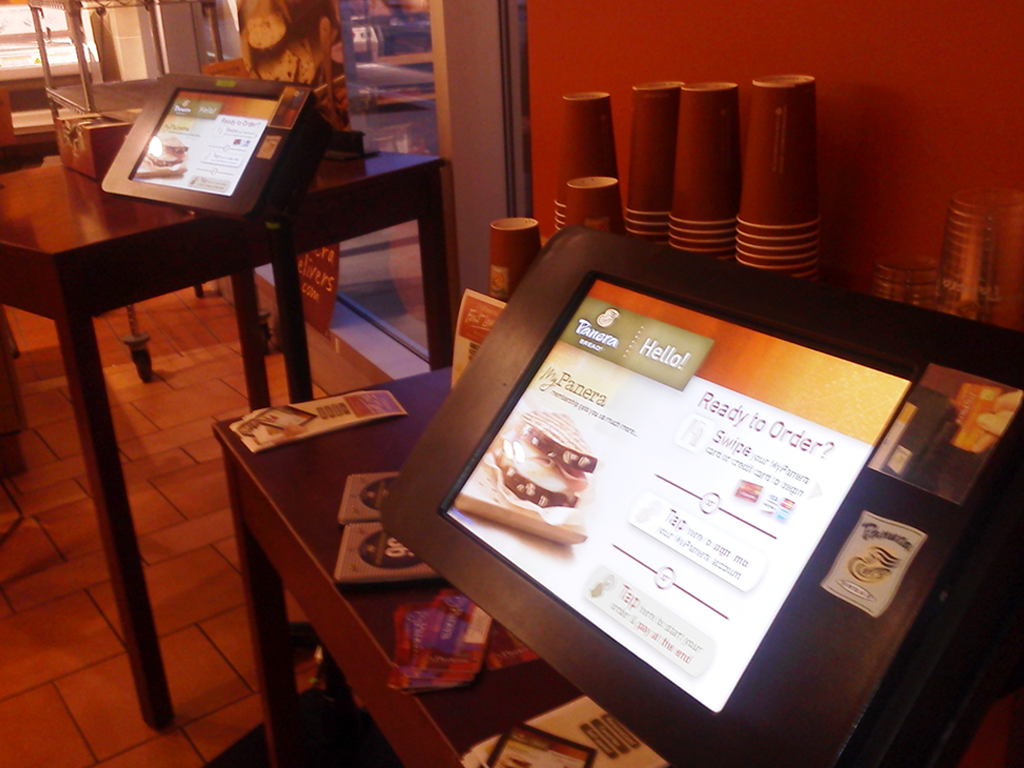
Our Panera recently went through a remodel which included the usual new coat of paint, new tables, and some new lighting. We also received these nifty new Panera kiosks where we, the adoring public, can place our orders.
The idea here is to forego the long line at the cash registers.
Jump to an open kiosk
Swipe your My Panera Card
Order
It’s that easy.
Panera Kiosk User Experience
My in-laws were in town several weeks ago when we first gave this a try on a very busy Sunday morning, probably the first week or so the kiosks were in operation.
It was a complete flop.
My in-laws were at the time-saving kiosk about 12 minutes and eventually had to get the help of one of the workers.
My wife and I also took our turn at a separate Panera kiosk while my in-laws found their way through the maze.
My wife’s order (You Pick Two with soup and salad) was fairly easy to get into the system, my kid’s order (grilled cheese, yogurt and white milk) took a little bit longer, but we eventually got it.
The wheels came off the cart when I tried to include my meal – Chicken Caesar Sandwich on sourdough, no tomato, extra sauce.
I scanned up and down the menu 14 times looking for my sandwich. No dice.
I eventually had to get one of the workers to help me. Still no luck. She went away and returned with the explanation that my sandwich was not on the kiosk menu, and that I would have to get in line to order my sandwich.
Seriously?
While stuck in kiosk purgatory I looked for the lady who was in line behind me before I jumped into this alleged fast lane. She was now at the register and making great progress ordering her food. My use-the-kiosk-to-save-time strategy had backfired.
At this point I was highly annoyed with the whole user experience, and got the feeling that this system’s days were already numbered.
Fast forward to today, about 8 weeks after our first experience.
I decided to give the kiosk another try.
After swiping My Panera card I found our previous order — my wife’s soup and salad, and my daughter’s grilled cheese had been saved by the system. I could order them again with one touch. Pretty slick!
I still could not find my Chicken Ceasar sandwich, but kinda expected that.
We paid for my daughter’s order at the kiosk, and jumped in the regular line to get my sandwich.
Side Note
[callout]I also just discovered a Panera Bread app that appears to be targeted for beta use in the Minneapolis area. I’ll have to investigate this further as it could be promising as well.[/callout]
Editorial
Panera is by far one of the best innovators I have found in the fast casual segment, and heaven knows I have spent more than my fair share of expendable income here.
This implementation of technology-for-the-masses is in the right direction, yet misses the mark in key areas.
If I can’t find my item on the menu, the system is broken.
If this takes longer than just standing in the regular line, the system is really broken.
As a user what I really like is the ability to have pre-packaged favorites that allow me to do just what we did with my daughter’s grilled cheese — swipe, pay, and go. Bang. Fast and easy. Just the way technology should be.
Panera could allow us to accumulate these favorites by
Having the kind people at the register say, “Would you like me to save this order as a favorite on your My Panera card so you can order from our kiosks next time and not have to stand in line?”
Allow me to go online and build my favorites — including the off-menu Chicken Caesar sandwich — so I can save them to my My Panera account. Next time I visit the kiosk, my favorite meal will be there just like my daughter’s grilled cheese.
I think the kiosks are a great idea that could really enhance my overall experience at Panera. In their current rendition, however, I just don’t see the kiosks ready for the general public unless the path to the kiosks comes through the existing register, just like back in the 70’s when bank tellers were showing people how to use ATMs.
If you have ever wondered about the Creator of the universe and His thoughts on your success, read on.
Does God Really Care About Me?
This one is easy to answer - of course He does. He created you, gave you gifts, and even gave you the freedom to reject him. He wound your strands of DNA to make you uniquely you. There won't be another one, and I don't believe He created you to live an unhappy life.
Does God Really Care About Your Success?
That is an entirely different question.
The term "success" can mean so many things. Here I tackle fame, money and power
If success means money...
I don't know that I can answer yes to that one. I just can't find overwhelming evidence in my life, in the lives of others, or in the Bible itself that God is overly concerned with my getting rich.
I do believe that every good thing that comes to me is from God. I have had some small wins in my life, and I have had some huge wins in my life. All of them came from God.
These good things didn't happen because I followed some how-to-get-ahead-at-work tips.
Success wasn't guaranteed just because I was working really hard. I'm sure all of us can relate to working really hard on something only to have it amount to nothing.
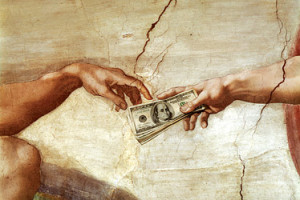
Now I like a good prosperity gospel as much as the next person. I like to think that God is just waiting to shower me with bars of gold should I just ask for his blessing. Yet there's a part of me that just doesn't want to turn God into a spiritual ATM that I turn to whenever I need to get out of a jam.
How do you feel about your "friends" who only come around when they need something? Yeah. See what I mean?
If success means fame...
I can't say that I can find a whole lot of evidence to back this one up either. While I do have a few friends who have some notoriety in their own circles, I can't say that they are famous.
You have to be careful about seeking fame. Michael Jackson is famous. So is the Unabomber.
If success means getting promoted at work...
I have met plenty of people who are living rather charmed lives. Most of their endeavors come up roses. It is amazing to watch because these people are not necessarily smarter or better connected. They aren't using some secret app or spending more time at the gym.
It just seems that God smiles on their efforts. Their work bears fruit.
Does God allow us to get ahead at work? Sure. God gives us skills, abilities, and opportunities. I can also recall several stories in the Bible that say things to the effect of "God gave him/her favor with…" Yes, I believe that God can give people an edge at work and an edge in their pursuits.
Check out this interesting article on God and Career from Relevant magazine.
Why Would God Be Against Me?
Let's rule out the basics. Let's assume that you are not bent on mass annihilation, or getting even with every last person who wronged you.
I believe that God will allow some hardship to come into your life (for more on this, just check out the book of Job as it is an entire story about one person's reaction when God allows tough circumstances into a person's life).
Why does God allow difficulties? This one has puzzled people for centuries. I can tell you the effect it has on me. It usually draws me closer to Him. When hardship comes there is typically
In one instance I believe that God closed the door to my going into full-time ministry in my earlier years, and I believe that God also closed a door on my time at an employer. I can't fully explain why, but I can tell you that I am happier.
A few days ago I did something that I had never done . I went snorkeling in Sharks Cove — a tropical tide pool. It was amazing!
Sharks Cove, located in the North Shore region of Oahu, is formed by a nearly perfect semi-circle of lava rock that starts on the shore to the left, arcs gracefully into the ocean about 100 yards, and then wraps back to the shore on the right side. This barrier serves as the breaker for the waves, thus creating the tide pool.
If seawater fills the tide pool slowly, then you get stunningly clear water. If, on the other hand, the water washes over the breaker, as was the case when we visited, then it stirs up the sediment.
Thankfully, the surf wasn’t too bad. As long as a rare wave — The Big One — doesn’t come over the wall, we should be in good shape.
A Local Provides a Warning
My wife and I went to the make-shift surf shop just across the street from the beach. Picture the burrito buggy from your local festival, make the buggy twice as long, and then fill it with all kinds of mostly new surfboards, flippers, and anything else you would ever want to rent for a day at the beach.
The place is dead empty as my wife and I stroll over to rent our gear.
“I haven’t really been renting much equipment today,” said the 50’s-looking local manning the booth. “The surf is coming up over the wall.”
“Yeah,” I said. Not really knowing just why he wasn’t renting today. Was he just not in the mood? I couldn’t get a bead on him at first.
“Where are you guys wanting to go?” he asked.
“Just across the street to Sharks Cove,” we answered.
“If you are going to go over there to Sharks Cove, I guess that would be ok. But you don’t want to get too close to that wall in case a swell comes over.”
“Ok,” I thought. “He’s coming at this from a safety angle.” That works for me. My wife and I promised to stay away from the wall, and then left with our snorkels, masks, and water shoes.
The shoes turned out to be life savers because a great part of the floor of this tide pool is all lava rock, which could make short work of bare feet.
Overwhelmed by Beauty
While the visibility may not have been up to par for the locals, I was amazed at what I could see under water. My visibility was about 10 feet in any direction, which allowed me to see more than I could take in.
The fish were beautiful and too many to count.
After about 30 minutes, I almost forgot I was wearing any gear. Another 10 minutes and I forgot I was even in the water. Somehow this all seemed so natural. Like I was meant to live in the sea, and that life was supposed to be this beautiful all the time.
Caught Unaware
Lost in visual bliss I was not keeping track of how close I had come to the wall separating the cove from the pounding surf outside.
A huge wave rushed over the barrier and into the tide pool – it was The Big One.
While under water I suddenly found myself being swept quickly about 5-8 feet toward the wall, and then — woosh! I was catapulted about 30 feet backward toward the shore all the while bouncing across every last piece of lava rock in my path.
I got pretty banged up. My knee took a bad shot. My wife had a few 3-inch cuts on her shin. We were both pretty shaken.
Banged Up but Rewarded
But isn’t this just like life? We have our heads down, working on some project that has our attention, trying to beat a deadline. Then, woosh! Something comes along and sideswipes us.
Something that we should have seen coming if we were paying less attention to the project and more attention to our surroundings.
Did my wife and I stop snorkeling, hang up our gear and do something safer? No way!
Did we pay closer attention? You bet. We kept a respectable distance from the wall.
About 30 minutes later we were rewarded for staying in — the sun came out.
I didn’t think it could get any better, but the transformation was remarkable. The light dancing through the ebb and flow of the water added an entirely new dimension to this inner space. The drab lava rock exploded in colors I hadn’t even noticed, and the colors of the fish were even more vibrant.
When life throws you, when the big one comes along and drags you across the rocks, get back in the water.
If you feel it is taking forever to find true work that resonates down deep in your soul, then this article is for you.
Years ago I called myself a business coach before most people even knew what a business coach was.
Sure, I felt like I was an innovative-ahead-of-the-curve guy back then, but the last place I needed to be as a one-person shop was innovative and ahead-of-the-curve. No one knew me, and even fewer people could understand what I did.
A nearly certain recipe for failure.
Then I tried my hand at being a financial advisor thinking that this was a good way to make ends meet while I got back on my feet. After a successful start in the business, in a very ironic twist, I ended up as a full-time business coach inside this Fortune 500 company.
Later my role morphed again to one where I essentially traveled most of the time as a software trainer. My dreams of self-employment were on the shelf, and quite frankly I had no idea where I was headed. I was lost.
Then the whole thing ended.
My trainer role, which was a contract position was extended and then extended again. I had hoped on getting another full-time position, but missed it after several tries. The last contract extension ended, and I was out.
At the end of a decade of trying and trying to make something happen for myself both as an entrepreneur and as a corporate employee, I felt like I had totally missed the mark.
I felt like a failure.
After some soul searching I realized that there were only two things that I could really call absolutes in my professional life.
I really like presenting, teaching, researching, and writing.
I love the freedom that comes with being self-employed.
Intentional Exploration Works
Immediately after my Fortune 500 job ended, I started working on a 1099 basis for a rather successful man who has had his own training company for years. I figured this would be a great way to learn the business side of training.
Now here I am two plus years later with my own business, building my own brand, and delivering my own sessions. I love it.
In many ways I think I have found home -- work that I could easily throw myself into for a long time to come.
What I want you to pay close attention to is this: Don’t mistake this for some story about a person who bumbled around haphazardly.
It is Called Effectuation
A short time ago while writing my dissertation I came across an article that radically changed my perspective on how long it took me to find true work.
I want to introduce you to a geek term called effectuation.
To explain effectuation, I will start with its evil twin, causation.
Causation says, “This is the product I want to build. This is the market I will target. I have planned my work, and I will work my plan.”
This is good as far as it goes, but things rarely ever go according to plan. What researcher Sarasvathy has done is to move the how-businesses-really-start-when-things-do-not-go-according-to-plan discussion out into the open light.
It turns out that a great number of companies, names you might recognize, did not end up looking anything like their initial plan!
At some point in building the business, the spreadsheets and the market analysis and the demand curves and all that other stuff the leaders learned in business school went out the window.
Instead, the “execute on the plan” mentality turned into something more like “let’s explore the space were in.”
Effectuation says, “Here is what I know. Here are the resources I have. Now, what kind of business can I build?”
Effectuation is an intentional exploration.
And -- most importantly -- it is a completely legitimate way to build a business.
As I was reading Sarasvathy's papers on effectuation I had this tremendous sense of relief. In some way, all my years of searching weren’t wasted. Instead, they pointed me to work that was truly mine. Work where I could accomplish things and make a difference.
Searching is Not Failure
I want you to know your time has not been wasted.
If you are currently looking and searching and bumping into walls and trying to follow a voice out of the maze, please hear me...
You are not a failure.
You are not some two-bit hack bumbling your way through life.
If you are reading this article chances are that you have a good head on your shoulders, and you have great intentions to bring something of great importance to the world.
Look at my path.
I followed my dream of owning my own business.
My first attempt didn't amount to much.
Then I took a job to make ends meet.
Then I had another taste of coaching.
Then I had a great experience as a traveling consultant/presenter.
Then I took work to learn the traveling trainer/consultant business.
Now I’m doing work I love, and I feel I’m making a true difference in people’s lives.
There is no spreadsheet in the world that could have told me any of this would happen.
This path isn’t predictive; This is an exploratoration.
If you have ever
Felt you have lost all chances of living up to your potential
Grown tired of searching for work that moves you
Felt that you are just going in circles
Then keep exploring!
All of your lost days and wasted time are not lost and wasted after all.
How I Learned to Play the Inner Game of Entrepreneurship
This is a story about what to do when your best plans go awry. I tell how I have learned a valuable skill that saves me so much time when dealing with setbacks.
Here is just one example of my ride on the emotional roller coaster.
I was marketing for a speaking engagement, and spent no small amount of time on one prospect in particular. It is an agency that I have done business with years and years ago.
Since I knew them, I didn't expect any surprises.
I was wrong.
A lot has changed with this agency, and their compensation has dropped to 1/3 of what it was in the past. Here is the range of emotions that I experienced in the span of 3 minutes.
Surprise - “What? I was getting paid way more than that several years ago!”
Anger - “That is so far below what the other agencies in this area are paying.”
Indignant - “Do I really want to work for that amount of pay?”
Remorse - “How in the world am I going to make it at those pay out rates?”
The most important part of this entire article -- are you paying attention here? -- is that I recognized where I was.
I stood at the junction between the exit ramp and the spin cycle.
This insight took me years to develop, and I can't tell you the amount of time I have wasted in the spin cycle of perpetual self-doubt.
What I explain next is the biggest lesson I have learned in playing the inner game of entrepreneurship.
Do a Reboot
As I mentioned elsewhere in my Get Back on the Horse article, so much hangs in the balance when you find yourself standing at this junction.
I've been here before, so I knew what to do. I had to reboot.
I had to do something else productive to get my mind off things. In about 15 minutes I was already looking for the positive, a way to rebound.
“I need to start looking for better-paying gigs.” “I’m worth it, and I know I can do it.”
Then fear tried to lay hold.
“I don’t even know where to look.”
Then, digging even deeper, I found hope. I had galvanized myself.
“Wait a minute...There’s this one group I could speak to, and there’s that other bucket of speaking opportunities I have not even approached, and there’s the referral group I’ve been wanting to build...”
At the end of my emotional cycle I was better off than before the unpleasant surprise, but notice that this didn't wrap up in a pretty bow in 5 minutes. There were a couple iterations up and down before settling on the positive.
How I Reboot
Notice that I consciously chose to do a reboot, to do something that would essentially change my mental direction.
This is the time-saving (life-saving?) thing that I was not good at many years ago.
Being able to realize where I am (in need of a reboot), and being able to do one successfully, has saved my bacon numerous times.
Doing a Reboot is often one of the following for me:
Putting it away. If the bad news came via email, I close the program. Get it off my screen.
Digging into one of my pet projects to move the pebble forward one or two blocks.
If this happens in the evening when my daughter is home, spending just 10 minutes with her is enough.
For you, it also could include:
Listening to 3 or 4 of your favorite songs.
Taking a quick 2o-minute walk in your neighborhood.
Calling one of your friends to de-stress for a few minutes.
(Dare I say it?) Facebook for 10-15 minutes (enter this time sink at your own risk).
Experience Gives You This Ability
So, if this little shock forced me to get better at what I do, and forced me to start thinking bigger about my future, was this experience such a bad thing?
What you have to understand is that this ride on the emotional roller coaster lasted about an hour, and the ride ended well.
It has taken me years to make the ride this short. Over a decade ago when I was just starting out, I did not know how to tame the ride.
Most often when I experienced some bad news, my ride usually ended with:
remorse
a heaping dose of self-doubt
spending the next week (or more) not making any progress.
Now I've been on the ride so many times that I have some perspective on it. I know what to expect.
I've fallen down so many times that I'm starting to get really good at getting back up. I can now recognize where I am, and choose the exit ramp rather than the spin cycle.
You can do this, too.
You can get back up faster than ever before.
A Reboot is Not Avoidance
A reboot is a short-term action to interrupt a negative line of thought, something you do to keep from going down the death spiral.
Avoidance behavior is some non-productive thing you do (filing) when you should be doing something productive (calling on prospective clients).
Wrap Up
The next time your business throws you a curve, use the three steps I use to win at the inner game of entrepreneurship.
Recognize where you are.
Choose the exit ramp.
Hit the reboot switch.
This muscle builds over time, and you will continue to get better and better at recovering from a setback.
If you feel it is taking forever to find true work that resonates down deep in your soul, then this article is for you.
Years ago I called myself a business coach before most people even knew what a business coach was.
Sure, I felt like I was an innovative-ahead-of-the-curve guy back then, but the last place I needed to be as a one-person shop was innovative and ahead-of-the-curve. No one knew me, and even fewer people could understand what I did.
A nearly certain recipe for failure.
Then I tried my hand at being a financial advisor thinking that this was a good way to make ends meet while I got back on my feet. After a successful start in the business, in a very ironic twist, I ended up as a full-time business coach inside this Fortune 500 company.
Later my role morphed again to one where I essentially traveled most of the time as a software trainer. My dreams of self-employment were on the shelf, and quite frankly I had no idea where I was headed. I was lost.
Then the whole thing ended.
My trainer role, which was a contract position was extended and then extended again. I had hoped on getting another full-time position, but missed it after several tries. The last contract extension ended, and I was out.
At the end of a decade of trying and trying to make something happen for myself both as an entrepreneur and as a corporate employee, I felt like I had totally missed the mark.
I felt like a failure.
After some soul searching I realized that there were only two things that I could really call absolutes in my professional life.
I really like presenting, teaching, researching, and writing.
I love the freedom that comes with being self-employed.
Intentional Exploration Works
Immediately after my Fortune 500 job ended, I started working on a 1099 basis for a rather successful man who has had his own training company for years. I figured this would be a great way to learn the business side of training.
Now here I am two plus years later with my own business, building my own brand, and delivering my own sessions. I love it.
In many ways I think I have found home -- work that I could easily throw myself into for a long time to come.
What I want you to pay close attention to is this: Don’t mistake this for some story about a person who bumbled around haphazardly.
It is Called Effectuation
A short time ago while writing my dissertation I came across an article that radically changed my perspective on how long it took me to find true work.
I want to introduce you to a geek term called effectuation.
To explain effectuation, I will start with its evil twin, causation.
Causation says, “This is the product I want to build. This is the market I will target. I have planned my work, and I will work my plan.”
This is good as far as it goes, but things rarely ever go according to plan. What researcher Sarasvathy has done is to move the how-businesses-really-start-when-things-do-not-go-according-to-plan discussion out into the open light.
It turns out that a great number of companies, names you might recognize, did not end up looking anything like their initial plan!
At some point in building the business, the spreadsheets and the market analysis and the demand curves and all that other stuff the leaders learned in business school went out the window.
Instead, the “execute on the plan” mentality turned into something more like “let’s explore the space were in.”
Effectuation says, “Here is what I know. Here are the resources I have. Now, what kind of business can I build?”
Effectuation is an intentional exploration.
And -- most importantly -- it is a completely legitimate way to build a business.
As I was reading Sarasvathy's papers on effectuation I had this tremendous sense of relief. In some way, all my years of searching weren’t wasted. Instead, they pointed me to work that was truly mine. Work where I could accomplish things and make a difference.
Searching is Not Failure
I want you to know your time has not been wasted.
If you are currently looking and searching and bumping into walls and trying to follow a voice out of the maze, please hear me...
You are not a failure.
You are not some two-bit hack bumbling your way through life.
If you are reading this article chances are that you have a good head on your shoulders, and you have great intentions to bring something of great importance to the world.
Look at my path.
I followed my dream of owning my own business.
My first attempt didn't amount to much.
Then I took a job to make ends meet.
Then I had another taste of coaching.
Then I had a great experience as a traveling consultant/presenter.
Then I took work to learn the traveling trainer/consultant business.
Now I’m doing work I love, and I feel I’m making a true difference in people’s lives.
There is no spreadsheet in the world that could have told me any of this would happen.
This path isn’t predictive; This is an exploratoration.
If you have ever
Felt you have lost all chances of living up to your potential
Grown tired of searching for work that moves you
Felt that you are just going in circles
Then keep exploring!
All of your lost days and wasted time are not lost and wasted after all.
Then keep exploring!
All of your lost days and wasted time are not lost and wasted after all.
I was working on my dissertation this past weekend. I was about 20 layers deep in my literature review when I decided to look up a term I hadn't seen before.
Then I saw this picture.
Image credit to Scholl, R. W. (2002). Motivation: Expectancy Theory. Retrieved at http://www.uri.edu/research/lrc/scholl/webnotes/Motivation_Expectancy.htm
It hit me like a whack on the side of the head.
I could see the past 12 years of my life in one image.
More importantly, I could put words to why my motivation flags from time to time.
The image lays out like an easy-to-read formula. Movitation equals Expectancy times Instrumentality times Valence. While these last 3 terms in the formula are a little too academic, they are easy to understand when we call them by different names.
Expectancy - If I put in effort, I expect to see results. If I push a working lawn mower across my yard, I expect it to cut the grass.
Instrumentality - Mowing the grass will win me the respect of my neighbors. A little more difficult to control. Here, having a good looking lawn is just a vehicle, an instrument, to get me what I really want.
Valence - Also known as the big picture goal. My neighbors will vote my yard as Best Lawn of the Neighborhood. Now I feel good about my self. Respected by my peers.
For me, a great deal of my motivation comes from valence. I want the big picture. I want to pursue my purpose, bring some kind of change to the way we look at work, make a difference in people's lives. This is what gets me started on my journey every morning.
Problem is that I often don't know exactly how I'm going to do that.
My expectancy is off. Way off.
When it comes to the nuts and bolts of growing my business I could choose from any one of a hundred things to get clients and speaking engagements. When I pick one of those ideas, and things don't work out, I begin cartwheeling into the land of uncertainty and low self-confidence.
As entrepreneurs most of us pursue a picture that we have of what our business should look like at some point in the future. It will be a certain size, employ (or not employ) a certain number of people, be located in this part of town… You get the idea.
Yet, most of us have little idea how we are going to do all that.
In order to grow your revenue this quarter you might plunk down some money on an ad campaign in the local coupon mailer pack. You might join a networking group. You might take a class on public speaking.
And when the mailer, and the networking group, and the class all amount to nothing, you pull back.
This picture was such an eye-opener for me because, in my early years, I was in a cycle of false starts. I wanted to do public speaking. I wanted to make a difference, but I couldn't get the first two parts of the formula to line up for me. It wasn't necessarily about knowing how to dial a phone and ask for a speaking gig. It was deeper than that.
I didn't know how to form a core message. I didn't know how to dig deep to articulate my big "why".
Without this core to my message, I feared I would end up just another talking head. Just one more guy who needs to be seen on a stage…any stage.
Even though I knew I still needed to hone my core message, I would pound forward anyway. Get a few speaking gigs. Most of them went really well…but something was missing. The core.
My motivation flagged, and I would pull back from speaking for a while to let things gel.
Now here I am years later. I had put speaking "on hold" for some time. Ok, a long time. I had put it on hold for so long that I had for all purposes forgotten that I wanted to make a big impact on people's lives. Then, a long series of events (which I will cover at another time) led me to a point where I saw what I felt were some pretty serious injustices with regard to entrepreneurs. I couldn't believe what I was seeing, but was powerless to really do anything about it.
At that point, so far from shore, so far from practically everything that meant safety and security to me, I found my core message.
I was working on my dissertation this past weekend. I was about 20 layers deep in my literature review when I decided to look up a term I hadn't seen before.
Then I saw this picture.
Image credit to Scholl, R. W. (2002). Motivation: Expectancy Theory. Retrieved at http://www.uri.edu/research/lrc/scholl/webnotes/Motivation_Expectancy.htm
It hit me like a whack on the side of the head.
I could see the past 12 years of my life in one image.
More importantly, I could put words to why my motivation flags from time to time.
The image lays out like an easy-to-read formula. Movitation equals Expectancy times Instrumentality times Valence. While these last 3 terms in the formula are a little too academic, they are easy to understand when we call them by different names.
Expectancy - If I put in effort, I expect to see results. If I push a working lawn mower across my yard, I expect it to cut the grass.
Instrumentality - Mowing the grass will win me the respect of my neighbors. A little more difficult to control. Here, having a good looking lawn is just a vehicle, an instrument, to get me what I really want.
Valence - Also known as the big picture goal. My neighbors will vote my yard as Best Lawn of the Neighborhood. Now I feel good about my self. Respected by my peers.
For me, a great deal of my motivation comes from valence. I want the big picture. I want to pursue my purpose, bring some kind of change to the way we look at work, make a difference in people's lives. This is what gets me started on my journey every morning.
Problem is that I often don't know exactly how I'm going to do that.
My expectancy is off. Way off.
When it comes to the nuts and bolts of growing my business I could choose from any one of a hundred things to get clients and speaking engagements. When I pick one of those ideas, and things don't work out, I begin cartwheeling into the land of uncertainty and low self-confidence.
As entrepreneurs most of us pursue a picture that we have of what our business should look like at some point in the future. It will be a certain size, employ (or not employ) a certain number of people, be located in this part of town… You get the idea.
Yet, most of us have little idea how we are going to do all that.
In order to grow your revenue this quarter you might plunk down some money on an ad campaign in the local coupon mailer pack. You might join a networking group. You might take a class on public speaking.
And when the mailer, and the networking group, and the class all amount to nothing, you pull back.
This picture was such an eye-opener for me because, in my early years, I was in a cycle of false starts. I wanted to do public speaking. I wanted to make a difference, but I couldn't get the first two parts of the formula to line up for me. It wasn't necessarily about knowing how to dial a phone and ask for a speaking gig. It was deeper than that.
I didn't know how to form a core message. I didn't know how to dig deep to articulate my big "why".
Without this core to my message, I feared I would end up just another talking head. Just one more guy who needs to be seen on a stage…any stage.
Even though I knew I still needed to hone my core message, I would pound forward anyway. Get a few speaking gigs. Most of them went really well…but something was missing. The core.
My motivation flagged, and I would pull back from speaking for a while to let things gel.
Now here I am years later. I had put speaking "on hold" for some time. Ok, a long time. I had put it on hold for so long that I had for all purposes forgotten that I wanted to make a big impact on people's lives. Then, a long series of events (which I will cover at another time) led me to a point where I saw what I felt were some pretty serious injustices with regard to entrepreneurs. I couldn't believe what I was seeing, but was powerless to really do anything about it.
At that point, so far from shore, so far from practically everything that meant safety and security to me, I found my core message.
When I talk to most new entrepreneurs, the easiest place for discouragement to enter is that of missed goals.
Why? The achievable question just hasn't been answered. Sure, "Make $2000 pursuing my dream in the next 30 days" is a great goal by most accounts.
It is pretty specific.
Certainly measurable.
Realistic, as far as that is concerned.
It meets the time-bound criterion with the 30-day deadline.
Yet the achievable question still remains.
How can we ferret achievable from unachievable?
Has this person made their first dollar "pursuing their dreams"?
Is this the right time of year for going after this kind of money?
Does this person have the right network, advertising skills, prospecting skills or other lead generation skills to make a go of this?
In the early years of my coaching business I knew I had problems prospecting for business, but the best advice I had ever been given was "Go hang out at the chamber of commerce." Sage advice, but not exactly a game changer.
It wasn't till 4 years later, after I had won a Sales Conference for my sales results as a financial advisor, that I could finally say that I had a good handle on prospecting. The problem is that I had to close down my coaching business to finally learn how to prospect.
Aiming too Low vs. Aiming too High
When I talk to most established entrepreneurs about achieving goals I find that most do a good job with setting goals that are achievable.
I was like a kid on the night before Christmas. I could not wait for my new goal setting kit to arrive!
It was all the rave with my entrepreneur friends, and most had already bought their sets. I didn't want to be left behind. It was expensive, but I took the plunge anyway.
Three months later the kit was on my desk, collecting dust.
I had worked through every page of every module, but my business was still nowhere near where I wanted it to be.
I just didn't get it. Why were my friends able to set goals and make progress? Why were they seeing growth and I wasn't? I was trying just as hard as they were.
I kept sticking to my guns. In all the books I had read and all the audios I had listened to, I had heard that "half of success is just showing up". Well, I had been showing up month after month, but the success wasn't showing up at all. I had been duped.
Does goal setting work?
Of course it does. Just look out your window. There are roads. You have electricity. You have running water. All these things were goals on someone's desk at some point. Somewhere a plan was drawn up, a schedule was put into place, and orders were given. Items got checked off the list and things happened. Done deal.
Setting goals does work, but there's a lot more to it than jotting your aspirations on paper.
So, when and where does goal setting work?
This may sound a little basic at first but bear with me. Goal setting works when people can actually do the work. Read that one more time really closely.
Why goal setting wasn't working for me
We've all heard the tired expression of setting SMART goals, right? Specific, Measurable, Achievable, and so on.
Here's the part that I had to admit to myself, and it took me a few years of distance and reflection to finally get to admitting this -- most of my goals were not achievable.
Achievable by me, that is.
In those early days I had written goals such as "develop a business with multiple streams of income", "have x number of clients in the next 90 days", "grow my revenue by y dollars 12 months from now".
Here is the vital problem with those goals -- I had absolutely no idea how to actually achieve any of that. I was taking the field of dreams approach. Write them and they will come.
I had also entered the land of unfair comparisons. At the time all my entrepreneur friends were at least a decade ahead of me. They had established businesses with established clientele. To some degree they had it easier. They could set goals that they actually had a good chance of achieving.
In contrast, I was still trying to figure out who I was and how to take that to the market. I had no idea if I should call myself a "coach" or a "consultant". I had absolutely no idea how to prospect for new business. After I was sitting in front of a prospect, my closing skills were mediocre at best.
All this sums to a fantastic beat-my-head-on-the-wall experience when it comes to achieving the goals I had set for growing my business.
How I broke the cycle of false starts
The key that really started turning things around for me was simple persistence. I just didn't give up.
Much easier said than done.
When I first started I didn't know much about selling my speaking engagements. I started small where I knew I could be successful. Most of my friends suggested pitching my presentations to local Rotary groups as they seem to be in constant need of speakers.
I was able to land several of these gigs with a couple emails and a few phone calls each.
My confidence started to increase.
Then I tackled paying gigs by reaching out to local community colleges. Again, I found success here.
My confidence increased even more.
Now I'm raising the bar again by pursuing gigs that pay even more. This has taken me quite a while to build, and my confidence is growing in stages.