by Jason R Owens | Feb 19, 2013 | New Financial Advisor, Uncategorized

New Financial Advisors
A Big Collection of Articles on what you can expect
I did a pretty broad search on the net today to find some of the best resources possible on what you can expect in your new career as a new financial advisor or a new insurance agent. My results cover a fairly broad spectrum of producers with wire houses on one end of the scale — traditionally producers here collect assets in the form of mutual funds, 401(k) accounts, IRAs, stocks, etc. On the other end of the spectrum we have property and casualty (P&C) who traditionally sell home owners insurance and car insurance. There are a variety of roles in between who sell a mix of investments and life insurance. Your job probably lies somewhere along this spectrum.
Forums for New Financial Advisors or New Life Insurance Agents
My largest area of surprise is how many forums exist for producers in the financial services industry. One in particular is Ampminsure.com. I managed to find one thread on the challenges that life insurance agents face.
The National Association of State Farm Agents also has a forum that is an invaluable resource for new life insurance agents in the P&C world.
InsuranceForums.net is another forum that even includes a section for General Agents. New insurance agents will want to check out the Getting Started Selling Insurance section on the forum.
There is even one small exchange on new life insurance agents on Indeed.com.
Interviewing with companies? For those of you who are considering becoming a new life insurance agent or a new financial advisor, this exchange between newbies and interviewees is very enlightening.
Articles for New Financial Advisors or New Life Insurance Agents
Fins.com has a pretty good collection of articles for new financial advisors, in particular.
The First 365 Days: How to Set Up For a Successful Career as a Financial Advisor is a great read for those of you who want an inside scoop on what it is like to work for a firm that gathers assets. The first sentence says it best, “Say goodbye to your friends.”
From Rookie to Retiree: Financial Advisor Lifecycles gives a great end-to-end perspective on what to expect. I particularly enjoy the quote from Joe Matthews who advises new recruits to “Hit the ground running”. Peter Izzo also points out that “its a meritocracy.”
This next article is a little dated, but brings up a great point in the hiring and training of new financial advisors. The article, The Future of the Industry is a general state-of-the-industry look at financial advisory services, and it quotes a price tag of $250,000 for launching a new financial advisor.
Videos
First Year Insurance Agent is a text-to-movie animation. While the language here is a little off-color at times, the video hits on a number of really relevant points including the expectations of management, and the need to market products outside of your company’s core portfolio. A little long at nearly 7 minutes. I feel the first 5 were well worth the time.
New Insurance Agent Mistakes to Avoid is a well-done video by what appears to be a mother-daughter team. At 2 minutes it is worth the time. This video illustrates a good point about avoiding competition with the internet.

by Jason R Owens | Feb 2, 2013 | High Attrition, New Financial Advisor
New Financial Advisor Success Tactics
Time Orientation
This is NOT another article on time management. Far from it. Instead, this is an article on preventing stress in your new job.
New Financial Advisors have enough to tend with during their first few months — licensing, class room training, computer-based training, filling the calendar with initial appointments — it can be overwhelming at times. In the midst of this there is one important thing to keep in mind. What is your time orientation?
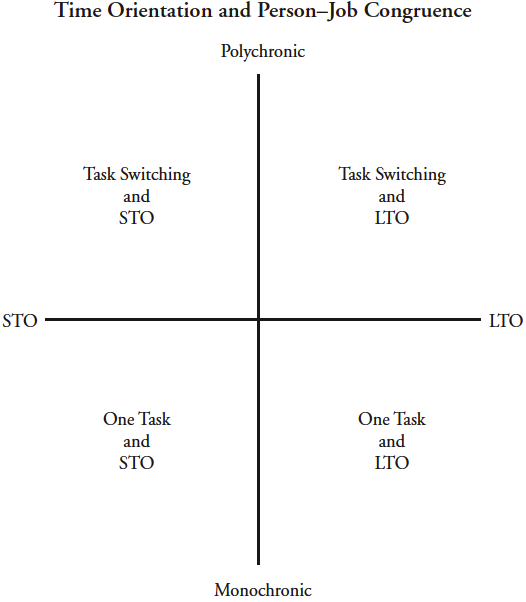
Researchers Weeks and Fournier (2010) studied how a person’s time orientation contributed to the stress that a person experiences as a sales person. The picture below says a thousand words. There are essentially four major types of time orientation. A person can naturally fall towards a long-term orientation (LTO) or a short-term orientation (STO). Meaning a person’s thoughts and actions fall somewhere on the spectrum between short-term and long-term. There is a second measure that a person needs to consider as well — multitasking. Some people love it. Others can’t stand it. One the graphic you will see the terms polychronic (multitasking) and monochronic (one thing at a time).
Time orientation is important to consider because a sales person who is accustomed to taking a long-term approach to sales will not fit well in an environment that demands short-term focus. The same can be said of task orientation. Some roles demand that the individual focus on many things at once. One could consider a person who does not enjoy multitasking as a poor fit for a job that requires such.
Reference
Weeks, W. A., & Fournier, C. (2010). The impact of time congruity on salesperson’s role stress: A person-job fit approach. Journal Of Personal Selling & Sales Management, 30(1), 73-90.
by Jason R Owens | Nov 25, 2012 | Faith and Work, Uncategorized
This is the 3rd post in a series that I am writing on God’s redeeming our every day work lives (article 1 and article 2). The series started when I came across a presentation by Dr. Denise Daniels of Seattle Pacific University.
After the fall came redemption, and this carries through to our time at work.
Until reading this presentation I had been of the opinion that the fall had doomed us to work in jobs that were monotonous, tedious and boring. Dr. Daniel’s presentation covered the fall, yet it made me realize that God, in fact, has redeemed work.
Dr. Daniels includes a vital observation on slide 22.
Your work can bring economic justice and social justice to people who can not speak for themselves.
Consider for a moment the considerable rise of social entrepreneurs over the past decade — organizations such as Charity:Water and LoveGrows. Charity:Water provides clean drinking water for those who otherwise would not have the means to obtain it. Clean water leads directly to better health for the villagers and improves education opportunities for girls and women. LoveGrows helps provide orphans with housing and access to age-appropriate schooling. Both organizations seek to create a cycle of empowerment at a local level.
These are not organizations that started as well-funded offshoots of major corporations or endowment funds. These are organizations that are started from people who simply said “I want to make a difference”, and they chose to get involved despite the many issues that lay before them.
The work that you do can have an amazing impact on the lives of many.
References
Daniels, D. (2008). Redeeming work: Living out God’s Purpose in our work [PowerPoint slides]. Retrieved from http://www.spu.edu/depts/sbe/cib/documents/CIB_Kiros_Redeeming_Work_Daniels_7-08.ppt
by Jason R Owens | Nov 21, 2012 | Self-Employed Sweet Spot
Sixty Minutes to Better Head Space
In about an hour you can completely transform how you feel about yourself and how you feel about your business. In an earlier post I mentioned how I was going to help a client find some opportunities by going door-to-door in a local business park today. We started about 9:40 and were done by 10:30. We intentionally chose to go prospecting on the day before Thanksgiving because it is a good time to catch decision makers who may not have front desk support staff working.
My client started with the approach of introducing himself and then saying, “I do graphic design work, redesign websites and layout brochures. I was wondering if there was anyone in the office that I could speak to about that.” Easy to say and straight to the point. Most visits were 5 minutes or less.
About half the time the gate keeper introduced us to someone else in the office who takes care of marketing.
We came across one doorway and my client stopped dead in his tracks. “I did that logo! I’ve worked for these people before. They were my clients about 2 years ago.” The office was closed for the holiday, but he made a note to check back with this long-lost client.
Towards the end of our hour my client said, “Everyone’s been so nice. There hasn’t been one person who said, ‘Hey, what are you doing here?'” That has been my experience as well. Most people are polite and receptive. Makes me wonder why people who want to build their business don’t go door-to-door more often.
“Everyone’s been so nice. There hasn’t been one person who said, ‘Hey, what are you doing here?'”
Wins
- We found one former client that is ripe for re-opening conversation.
- Received permission to come back to one prospect with recommendations for how he would improve existing communication pieces (web, brochures, logo, etc.).
- Found one big fish prospect. We have good rapport with the gatekeeper who invited us back.
- Opened discussion with one medical practice who welcomed more conversation.
- Discovered one key-man office space that could be a door to her existing 25 clients.
by Jason R Owens | Nov 21, 2012 | Self-Employed Sweet Spot
Canvassing a Business Park
If public speaking is the number one fear of people, then making door-to-door sales calls has to be a close second. In just a few hours I will go with a client of mine to try to drum up business for him. Like you, this client has a great set of skills, great talent and a great portfolio. He just needs to get his stuff in front of more people, and this is one of the most direct ways that I know to help him develop relationships.
My Approach
Here is what I have learned in the past when doing door-to-door canvassing in a business park.
The purpose for this visit isn’t to barge right in to see the owner because that is really off-putting to most people. Instead I make the purpose of the visit to learn what I need to do to get an appointment. I know that a lot of trainers/coaches would not agree with me on this point, saying that I move too slowly. I’m taking more of a long-term view here rather than a high-volume turn-and-burn approach.
- Nine times out of 10 I meet a gatekeeper at the front desk (Always be nice to these people or you are sunk). The people in these front desk positions are quite attuned to fielding salespeople, so I usually do not take the tact of asking to see the person in charge.
- I ask what the process is for getting to speak with the owner / person in charge. You learn a great deal from the answer to this question.
- I also ask what days of the week are good for getting a short appointment, and I emphasize that I am usually looking for only 10-15 minutes. The important part here is that I’m not looking to give the owner my life story. All I want is a simple face-to-face meeting where I have a chance to make a connection.
Why Not Use Social Media?
Given all the hype on using social media, email marketing and networking events to generate business, you might ask why not use one of those methods. Simple, for small businesses that have only 1 or two people, I have found that there is just no better way to quickly get the ball rolling than phone calls and face-to-face conversation. You can send out emails all days long, but you won’t get far unless you follow up the emails with a phone call.
“Yeah, I got your email. You know we were just talking about [insert your service here — redoing our website, remodeling the kitchen, buying a new copier]. Why don’t you stop by the office sometime next week?”
For the small business owner I have found social media is a great tool that you want to use with a more traditional sales approach such as follow-up phone calls or walk-ins.
Stay Tuned
As long as there are no last-minute complications today I plan on posting an update this evening of the results of what happens during today’s walk-ins. Stay tuned.
by Jason R Owens | Nov 15, 2012 | Uncategorized
Research Should be Transferrable
In an earlier post I discussed why research should be generalizable. Here I will cover transferrability which is equally powerful. I will continue with my example where we had a hypothetical study showing that nurses who worked 8-hour shifts committed less errors than nurses who worked 12-hour shifts.
Transferability means that the original findings have been shown to work across many additional industries.
For a finding such as this to be transferrable, one would have to see similar results in different industries such as manufacturing, engineering, hotel management, newspaper production, etc. Not all research is meant to be transferrable or generalizable; however, if it is found to be transferrable it is an indicator that the findings may very well be replicable in your organization.
by Jason R Owens | Nov 14, 2012 | High Attrition
The Secret to Motivating Employees Toward Peak Performance
From time to time we are lucky enough to hire a shooting star, that one employee that is worth 5 or 10 regular players. The holy grail, of course, is getting our regular players to perform like shooting stars. Most of them are quite capable of reaching higher, but year after year they settle for being, well, regular.
The key to employees who are continuously motivated comes from three components:
- Competence – belief that one has the ability to influence important outcomes
- Autonomy – having a choice and fully endorsing what one is doing
- Relatedness – having satisfying and supportive relationships
When all 3 components are at work, employees have higher levels of motivation and put forth more effort.
I am drawing from an impressive body of research from Deci and Ryan who have put their Self-Determination Theory (SDT) to the test in industries as varied as “business, education, sports, medicine, entertainment and leadership” (Stone, Deci & Ryan, p. 76, 2009). The researchers offer the following six practices to creating the environment where continuous motivation will flourish
- Ask open questions and invite participation in problem solving
- Actively listen and acknowledge employee perspectives
- Offer choices within structure including the clarification of responsibilities
- Provide sincere, positive feedback that acknowledges initiative and factual, non- judgmental feedback about problems
- Minimize coercive controls such as rewards and comparisons with others
- Develop talent and share knowledge to enhance competence and autonomy (Stone, Deci & Ryan, p. 80, 2009)
I do not mean to trivialize how important or easy it would be to grow your culture towards continuous motivation, but the rewards are well worth the bumps along the way.
Reference
Stone, D., Deci, E., & Ryan, R. (2009). Beyond talk: Creating autonomous motivation through self-determination theory. Journal of General Management, 34(3), 75–91.
by Jason R Owens | Nov 14, 2012 | Uncategorized
The Two Things Jason Does Best
I am first and foremost a writer. This is how I develop my craft and hone my message. It is through writing that I start the process of putting my ideas into a form that I can take to market.
I write so that people can benefit from my past experience. Perhaps people can learn from my success and my failures.
I am a researcher. I read a great deal of academic journals because it makes perfect sense to take advantage of so much great work that has already been done. This is called secondary research. Despite so much great work being available, there are still times when I need to roll up my sleeves to do my own interviewing and data collecting. This is called primary research.
The reason that I perform research is to help an organization solve a problem with its sales force, or to help individuals produce at higher levels.
For me this is the perfect blend between work and ministry, between being an entrepreneur and working in a large company, between being a researcher and having my feet on the ground in the trenches.
by Jason R Owens | Nov 12, 2012 | High Attrition
Emotional Management for the Small Business Owner
The Path Out of Desperation
Years ago while in the throws of running a business there were times when I absolutely needed a deal. I was desperate. I needed to generate revenue, and the big fish prospect right in front of me had a legitimate need. If I timed this just right I could get myself out of a tight spot. The problem is that the deal never, and I mean never, materialized when I needed it. I was left to scramble to find money elsewhere. I doubted both my calling and my ability. After experiencing this emotional and financial roller coaster enough times I realized that there was only one way out of the doom loop — I had to have more than one big deal in my funnel at a time. I worked extra hard and started putting more and more medium deals in the funnel. These were far easier to get and I started to get good at it. It was a LOT of work, but I managed to do it. I did it so well that I won a sales conference trip that year.
The Secret of Inventory
One of the tools that I found invaluable is a simple low-tech tool called a follow-up file. This is NOT your to-do list for closing a deal. Instead think of this a long-term follow-up. This is where you capture every last time a client says “I’m not interested now, but after (insert reason here) the vacation is over, school starts, the beginning of the year, etc. I would write it down. Every one of them. Try this yourself. If you are in a business where you talk to new prospects 5-10 times per week, you will amass a good inventory in about 90 days. The great part about this that once you get into the rhythm of entering items into your follow up file, you won’t want to stop. My big surprise was looking back on this list from a harvest perspective after 3 months. I had managed to stack up several pieces of low hanging fruit. Many of those “call me later” deals were ripe for the picking. It worked great.
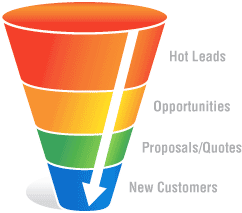
What Exactly is a Sales Funnel?
In this case a picture is worth a thousand words. For the uninitiated a sales funnel is simply a list of all your deals, and the list is segmented by stages. Some deals are just at the beginning stage while others are just about to be closed. When you get up each day, take a look at your funnel and ask one important question – “What do I need to do today to move each of these deals to the next step in the funnel?”
What do I need to do today to move each of these deals to the next step in the funnel?
It is a simple question that cuts through all the clutter and distraction. If today’s to-do list does not include directly moving all of your deals an inch closer to your wallet, you are working on the wrong things.
Take Aways
Here is a list of the top things you can do to keep your head in the game.
- Commit to building an inventory. No technology required. Just use a yellow pad of paper or a white board in your office. Write down every deal that you see, no matter how far out in the future it may be. Revisit this list often. You’ll be glad you started.
- Track all your prospects in a sales funnel. Make it your mission everyday to move each deal one step closer to completion.
- Work hard. Yes, that’s right. Work hard. Your dreams are in reach.
by Jason R Owens | Nov 6, 2012 | Uncategorized
Last night I submitted my last paper for my last doctoral class. Now all that is left is my dissertation.
It feels great!